Which phones have MagSafe? Every iPhone, plus Pixel and Galaxy
A model-by-model list of which iPhones have MagSafe and how fast each charges on it, plus which Pixel and Galaxy phones have magnets and which need a magnetic case.
Written by the YOONIG team · Updated · 6 min read

Every iPhone from the 12 on, minus three exceptions
Every iPhone from the iPhone 12 onward has MagSafe except the iPhone SE (2nd and 3rd generation) and the iPhone 16e. The iPhone 17e brought it back to the budget line. No Android phone has MagSafe by that name, but the Pixel 10 series has the same kind of magnet ring built in under the Qi2 standard, and Samsung's Galaxy S25 and S26 get it through a magnetic case.
MagSafe is Apple's name for a ring of magnets around the charging coil that lines up chargers and holds accessories. Qi2 is the open standard built on the same idea. Which one a phone has decides what snaps to it, and how fast it charges once it does.
Every iPhone, with its top MagSafe charging speed
Speeds are Apple's peak figures for its own MagSafe Charger (Apple: How to use your MagSafe Charger). The 25W tier needs a recent MagSafe Charger and a 30W or stronger adapter; the 15W tier needs a 20W or stronger USB-C adapter. Apple also notes that a cable accessory plugged into the phone, such as wired headphones, limits wireless power while connected: 16W on the iPhone 17, iPhone Air and 18 Pro models, 10W on the 17 Pro models and 7.5W on the iPhone 16 line and earlier. Why speeds differ is covered in how fast does MagSafe charge.
| iPhone | MagSafe | Peak MagSafe charging |
|---|---|---|
| iPhone 18 Pro, 18 Pro Max | Yes | Up to 25W |
| iPhone 17 Pro, 17 Pro Max, iPhone 17 | Yes | Up to 25W |
| iPhone Air | Yes | 20W |
| iPhone 17e | Yes | Up to 15W |
| iPhone 16 Pro Max, 16 Plus | Yes | Up to 25W |
| iPhone 16, 16 Pro | Yes | 22.5W |
| iPhone 16e | No | Qi wireless charging, no magnets |
| iPhone 15, 15 Plus, 15 Pro, 15 Pro Max | Yes | Up to 15W |
| iPhone 14, 14 Plus, 14 Pro, 14 Pro Max | Yes | Up to 15W |
| iPhone 13, 13 Pro, 13 Pro Max | Yes | Up to 15W |
| iPhone 13 mini | Yes | Up to 12W |
| iPhone 12, 12 Pro, 12 Pro Max | Yes | Up to 15W |
| iPhone 12 mini | Yes | Up to 12W |
| iPhone SE (2nd and 3rd generation) | No | Qi wireless charging, no magnets |
| iPhone 11, 11 Pro, 11 Pro Max | No | Qi wireless charging, no magnets |
| iPhone X, XS, XS Max, XR, iPhone 8, 8 Plus | No | Qi wireless charging, no magnets |
iPhones without MagSafe: 11, X, 8, SE and 16e
These phones charge wirelessly on any Qi pad, including a MagSafe Charger, because MagSafe chargers are Qi chargers too. What they lack is the magnet ring. Apple says power and charge times differ when a MagSafe Charger charges a non-MagSafe Qi phone, and names the iPhone 16e, the iPhone 11 models, the iPhone X, XS models, XR and iPhone 8 models. The charger rests on the back and has to be lined up by hand.
The iPhone 16e is the one that catches people out, because it sits in the middle of a run of MagSafe phones and looks like one. It isn't. The iPhone 17e that followed it is, at up to 15W.
A magnetic case can give an older iPhone something for accessories to grip, but it doesn't change how the phone charges. It still charges at its own Qi rate. We don't make magnetic cases for these models: for the iPhone 12 line and earlier we make Slim and Tough, and for the 16e and 17e, Clear and Tough.
Google Pixel: magnets built in from the Pixel 10
Google calls its magnetic accessories Pixelsnap and says they use the Qi2 magnetic standard. Its help page lists the Pixel 10, 10 Pro, 10 Pro XL and 10 Pro Fold and the Pixel 11 series as Qi2 phones, and says Apple MagSafe accessories are compatible with Pixel 10 and 11 series phones, excluding the Pixel 10a (Google: Learn about Pixelsnap accessories). The Wireless Power Consortium describes the Pixel 10 family as the first major Android line with magnets built into the phone itself.
Earlier Pixels charge wirelessly without magnets. Google's spec pages describe the Pixel 6, 7, 8 and 9 lines as Qi-certified, and Google says it isn't recommended to use the Pixelsnap Charger with previous Pixel phones.
Google adds a warning that applies to cases: magnetic attachment and wireless charging work best with no case or with a case designed for Qi2, and non-magnetic cases result in weak or no attachment and unreliable charging. Our Pixel cases are Tough cases for the Pixel 6 to Pixel 9 lines, made for wireless charging and without magnets. The full Pixel story is in does Google Pixel have MagSafe.
Samsung Galaxy: Qi2 Ready, magnets in the case
No Galaxy S phone has magnets inside. The Wireless Power Consortium describes the Galaxy S25 and S26 series as Qi2 Ready: the phones have no magnets, and they deliver the full magnetic experience once paired with an approved magnetic case (WPC: How do magnetic chargers work). Samsung sells its own magnet cases for the S26 line, and its accessories page rates them for wireless charging up to 25W.
Older Galaxy phones, back to the S20, charge wirelessly on Qi pads with no magnetic alignment. An Apple MagSafe charger will charge any of them as a Qi charger, but it won't snap on.
We don't make a magnetic case for Galaxy phones; our Galaxy builds are Tough, Slim, Clear and, for the S25 line, Silicone. If magnets matter to you on a Galaxy, the options are laid out in does MagSafe work with Samsung and Android.
| Phone | Magnets | Wireless standard |
|---|---|---|
| Pixel 10, 10 Pro, 10 Pro XL, 10 Pro Fold | Built in | Qi2 (Pixelsnap) |
| Pixel 11 series | Built in | Qi2 (Pixelsnap) |
| Pixel 10a | No | Excluded from Google's MagSafe compatibility list |
| Pixel 6 to Pixel 9 lines | No | Qi-certified |
| Galaxy S25, S25+, S25 Ultra | No, needs a magnetic case | Qi2 Ready per WPC |
| Galaxy S26, S26+, S26 Ultra | No, needs a magnetic case | Qi2 Ready per WPC |
| Galaxy S20 to S24 lines | No | Qi wireless charging |
MagSafe, Qi2 and Qi2 Ready: what the three labels mean for you
The three names describe where the magnets live. MagSafe phones have Apple's ring inside. Qi2 phones, like the Pixel 10, have a ring to the same open specification inside. Qi2 Ready phones, like the Galaxy S25 and S26, have the charging hardware but rely on a case to supply the magnets.
In practice that means a certified Qi2 charger snaps to a MagSafe iPhone or a Pixel 10 bare, and to a Galaxy S26 only through a magnetic case. Apple's MagSafe chargers work on Qi2 phones too, with the speed limits each maker sets. How the standards line up, tier by tier, is in MagSafe vs Qi vs Qi2.
Keeping MagSafe working with a case on
A MagSafe iPhone only keeps its snap through a case if the case carries its own magnets, because any case adds distance and magnetic pull drops off fast. A regular case still lets the phone charge; the charger just won't lock on, and wallets and mounts won't hold. Whether that matters for the way you charge is covered in do you need a MagSafe case.
Our magnetic builds start at the iPhone 13. MagSafe compatible and Card holder run from the iPhone 13 to the 18 Pro models (the 13 mini gets Card holder and Clear MagSafe only), Clear MagSafe from the iPhone 13 to the 17 line, and MagSafe + camera guard for the iPhone 16 Pro, 17 Pro, 17 Pro Max, 18 Pro and 18 Pro Max. Each case fits one exact model. Browse them in MagSafe phone cases.
Frequently asked questions
Does the iPhone 12 have MagSafe?
Yes. The iPhone 12, 12 mini, 12 Pro and 12 Pro Max were the first iPhones with MagSafe. Apple lists the 12 mini at up to 12W on its MagSafe Charger and the others at up to 15W.
Does the iPhone 16e have MagSafe?
No. The iPhone 16e has Qi wireless charging but no MagSafe magnets. The iPhone 17e does have MagSafe, at up to 15W.
Are all iPhones MagSafe?
No. MagSafe started with the iPhone 12. The iPhone SE models, the iPhone 16e and every iPhone before the 12 don't have it.
Does the Pixel 9 have MagSafe?
No. The Pixel 9 line charges wirelessly on Qi pads without magnets. Google's built-in Qi2 magnets start with the Pixel 10 series, excluding the Pixel 10a.
Is there MagSafe for Samsung?
Galaxy phones have no magnets built in. The WPC calls the Galaxy S25 and S26 Qi2 Ready, which means a magnetic case supplies the ring that chargers and accessories attach to.
Can a MagSafe charger charge a phone without MagSafe?
Yes, as a Qi charger. Apple says power and charge times differ on non-MagSafe Qi phones such as the iPhone 16e and iPhone 11, and the charger won't hold itself in place.
Shop the story
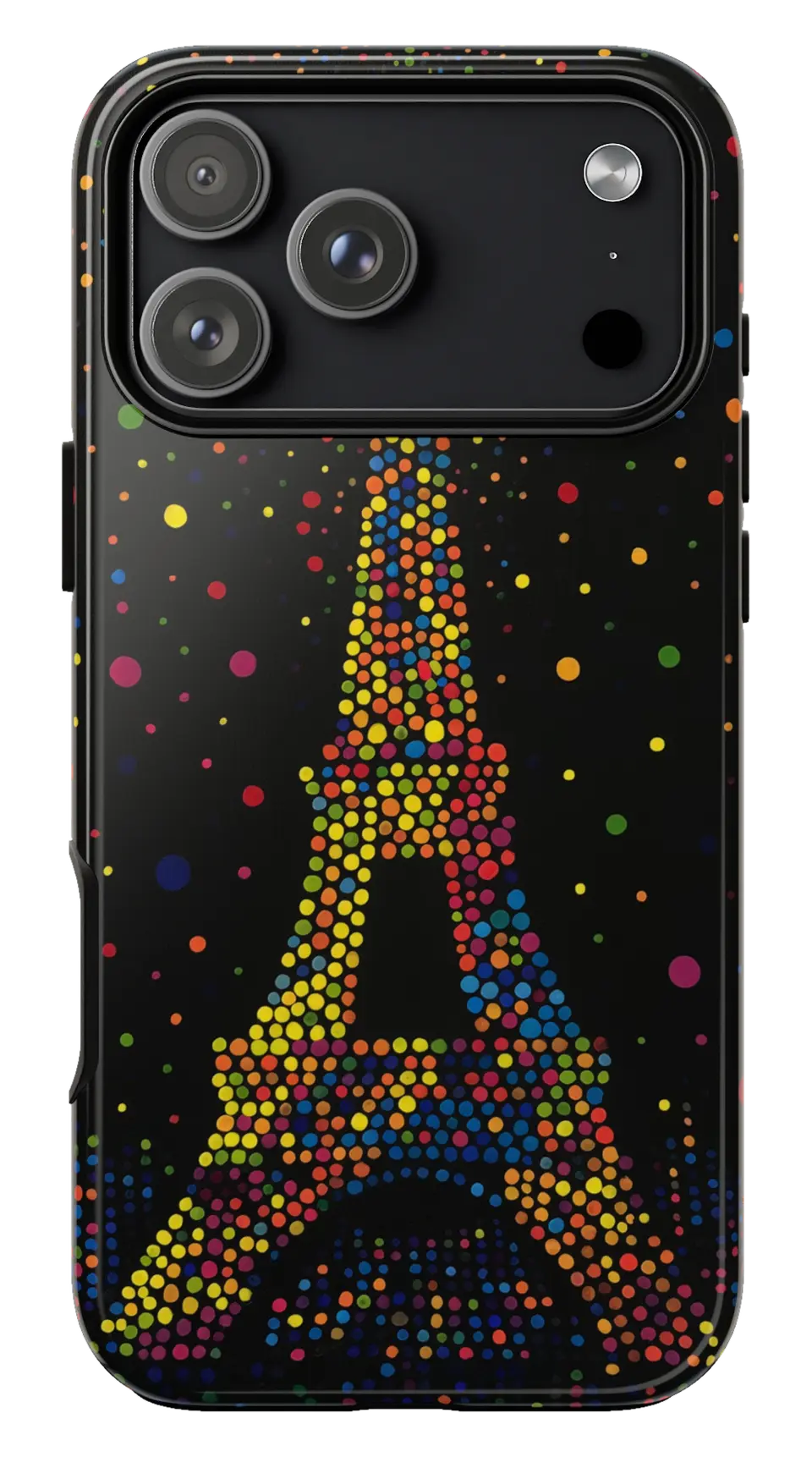 Paris Eiffel Tower Night Phone CaseFromCA$39.00Phone case · choose your model
 Chrome Phone CaseFromCA$39.00Phone case · choose your model
 Navy Gold Cloud Print Phone CaseFromCA$39.00Phone case · choose your model


